
Documenting AP and CLEP Exam Scores on Homeschool Transcripts
What if the college-level exam scores your teen worked so hard to achieve end up confusing admissions officers instead of impressing them? You already know how demanding advanced study is, and you want every ounce of that academic rigor to shine on paper. Still, documenting AP and CLEP exam scores on homeschool transcripts often feels like solving a puzzle with shifting rules. It's completely normal to worry about double-counting credits, improper GPA weighting, or mislabeling courses that lacked official syllabus approval. After all, high school coursework tells one story, while external testing validates another!
The good news? You can easily turn that record-keeping stress into total clarity. In this guide, you'll learn how to format, label, and document AP and CLEP scores on your homeschool transcript to maximize college admissions success. We'll walk through official naming conventions, clean layout options, and GPA weighting strategies so you can present your student's achievements with complete confidence.
Key Takeaways
- Understand the vital distinction between high school course credit and college exam credit to keep your student's records completely transparent.
- Master official College Board naming conventions so you can label coursework correctly and avoid trademark pitfalls when self-studying.
- Discover the best layout strategies for documenting ap and clep exam scores on homeschool transcripts without cluttering academic history.
- Learn standard GPA weighting rules to properly highlight advanced academic rigor without triggering admissions red flags.
- Explore how modern transcript tools help you organize testing milestones and digital score reports in one stress-free place.
Why Documenting AP and CLEP Exam Scores Matters for Homeschoolers
Your homeschool transcript is much more than a routine checklist of finished textbooks. It serves as the primary narrative of your student's high school journey! While parent-assigned grades showcase daily dedication and mastery at home, college admissions officers constantly search for objective benchmarks to contextualize those achievements. That is why documenting ap and clep exam scores on homeschool transcripts makes such an immediate, positive impact during holistic admissions reviews. Thoughtful documentation transforms a standard transcript into a compelling showcase of college readiness.
Providing External Academic Validation to Admissions Officers
Admissions counselors review dozens of applications every hour. While some college-prep forums suggest schools only look at official College Board reports sent downstream, your transcript creates that vital first impression. Standardized scores offer clear, third-party proof that an "A" on your student's record represents genuine mastery. Voluntary testing demonstrates exceptional self-discipline, especially for independent learners. Highlighting these scores directly on the transcript immediately validates course rigor, giving admissions committees full confidence in your home-based evaluations.
Understanding the Core Differences Between AP and CLEP
Before recording test results, it helps to distinguish how each testing pathway operates. Administered by the College Board, the Advanced Placement (AP) program features 42 courses and exams designed around rigorous, year-long study paired with cumulative spring assessments. These tests measure deep analytical skills and standard college-level curricula.
Meanwhile, the CLEP system offers 34 exams that focus purely on credit-by-exam mastery. CLEP tests do not require a specific preparatory curriculum, making them ideal for students who acquire college-level expertise through independent reading, life experience, or accelerated homeschool study. Knowing the structural differences makes documenting ap and clep exam scores on homeschool transcripts simple and transparent:
- AP Exams: Often grant advanced course placement, credit hours, or both at selective universities.
- CLEP Exams: Recognized by nearly 3,000 colleges and universities, primarily satisfying introductory general education requirements.
- Credit vs. Placement: AP scores frequently satisfy core major requirements, whereas CLEP typically helps students bank transferable college credit hours to bypass general prerequisites.
Presenting both types of exams clearly ensures universities recognize your student's ambition without any confusion about where high school learning ends and college credit begins.
Official Naming Conventions and Transcript Formatting Standards
Precision matters when you translate advanced coursework into an official academic document. While displaying the letters "AP" on a high school record shows colleges you're motivated to succeed, strict trademark regulations govern how you present those credentials. Properly documenting ap and clep exam scores on homeschool transcripts protects your integrity and keeps admissions officers focused on your student's true capabilities.
The College Board AP Course Audit Labeling Rule
Did you know the term "AP" is a registered trademark? You cannot simply label a self-designed course "AP US History" because your student studied an advanced textbook and sat for the May exam. Only courses that officially pass the College Board AP Course Audit earn authorization to carry the standalone AP moniker in course titles. If you designed the syllabus at home without audit clearance, label the course accurately: "Honors US History (with AP Exam)" or "Advanced US History." This subtle distinction satisfies legal guidelines while showcasing high-level rigor.
Assigning High School Credits vs. College Credit by Exam
High school credits represent academic time and instruction, typically measuring one full Carnegie unit (around 120 to 180 hours) for a year-long class. Passing an exam should never replace that core record of learning! When planning your layout, avoid these common credit pitfalls:
- Avoid Double Counting: Do not award one credit for coursework and a separate high school credit for the exam itself.
- CLEP Documentation: If a student earns credit purely by exam without a dedicated preparatory class, list it under a designated "Credit by Exam" section rather than a graded academic term.
- Transparency First: Ensure every high school unit maps directly to actual study completed during the semester.
GPA Weighting Strategies for Advanced Exam Courses
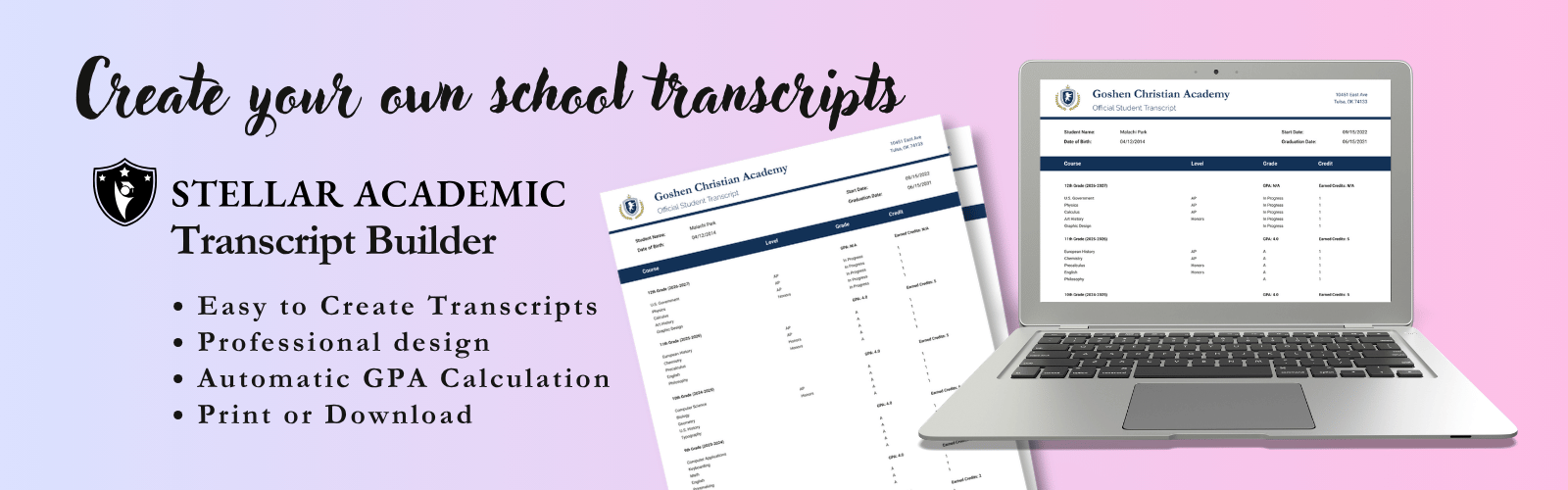
Standard practice allows an extra grade point for rigorous courses: a +1.0 boost for authorized AP subjects and a +0.5 boost for honors-level prep classes. When calculating your student's GPA, report both weighted and unweighted cumulative averages side by side. Always include an explanatory grading legend directly on the transcript. Utilizing a professional transcript builder helps you apply these weighted calculations automatically, ensuring your student's academic records remain polished, accurate, and completely transparent across every high school year.
Comparing Transcript Layouts: Where to Place Test Scores
Visual presentation can make or break how quickly an admissions officer digests your student's achievements. When you sit down to organize test scores, you face a major aesthetic choice: should exam scores sit directly next to daily coursework, or do they belong in their own designated section? Selecting the right visual layout brings instant polish to your academic records. Done right, documenting ap and clep exam scores on homeschool transcripts provides maximum impact while keeping your document remarkably easy to read.
Dedicated Testing Section vs. Integrated Course Notes
Many online parent forums suggest squeezing exam results directly into the course title column. In reality, that habit crowds the page and confuses automated transcript readers. A cleaner method is placing a dedicated "Standardized Testing" block at the bottom or along the side margin of the document. As highlighted in the College Board Guide for Homeschoolers, external assessments serve as standalone benchmarks. Isolating test dates and scores into a small, elegant table ensures primary course grades remain uncluttered while testing milestones stand out cleanly.
Managing Unreported or Sub-Optimal Exam Scores
What happens if your student earns an "A" in a rigorous history curriculum but freezes on test day, scoring a 2 on the AP exam? Remember, high school transcripts primarily document completed coursework, not mandatory score dumps. You retain full control over how you present external test data:
- Omit Low Scores Confidently: You are under no obligation to record an unfavorable exam score on the high school transcript. Your student's course grade reflects months of sustained effort, not a single testing afternoon.
- Leverage Test-Optional Policies: Many universities operate under test-optional admissions paths. If an exam outcome does not showcase your student's true caliber, let the course grade and textbook reading list speak for themselves.
- Official Sends Over Self-Reporting: Colleges require official digital files directly from testing organizations to award college credit anyway. Leaving lower scores off the main transcript keeps the focus entirely on genuine academic strengths.
Thoughtful placement ensures that documenting ap and clep exam scores on homeschool transcripts highlights your student's greatest triumphs, giving admissions committees an immediate, glowing summary of academic excellence.
Step-by-Step Guide to Documenting AP and CLEP Scores Accurately
Ready to put theory into practice? Building a transcript that admissions officers respect does not have to be an intimidating chore. Following a structured roadmap ensures you capture every academic milestone correctly while keeping your documentation organized for college deadlines. Here is your linear plan for documenting ap and clep exam scores on homeschool transcripts with complete precision.
Step 1: Audit Course Titles and Credit Allocations
Start by verifying the pedigree of each class. Review your syllabus records: did you complete an authorized audit course, or did your student study independently alongside an advanced curriculum? Assign compliant names such as "Honors Chemistry (with AP Exam)" or "Macroeconomics (CLEP Prep)". Next, assign standard high school credits based on coursework completed. Grant one full credit for a year-long class, keeping standalone credit-by-exam distinctions separate for independent testing.
Step 2: Build the Standardized Assessment Summary Block
Design an independent testing block on the transcript to display raw numbers cleanly. Include three straightforward columns: Test Name, Administration Date, and Earned Score:
- AP Scoring: Record numerical results on the standard 1 to 5 scale.
- CLEP Scoring: Record numerical scaled scores, which range from 20 to 80.
- Administrative Footnote: Add a brief statement beneath the table: "Official score reports sent directly to institutions via College Board." This signals absolute professionalism!
Step 3: Assemble Supporting Course Descriptions and Records
Admissions teams often request comprehensive course descriptions to verify rigorous homeschool coursework. Draft a short summary for each advanced subject, outlining textbook titles, primary themes, and laboratory components. Alongside this document, maintain a permanent digital archive of official College Board score reports. Keeping downloaded score verification PDFs organized alongside course descriptions saves immense time when college portals request instant uploads.
Ready to organize your high school files without the manual formatting headaches? Use our academic record keeping software to organize your homeschool transcripts and manage digital records seamlessly in one centralized hub!
Streamlining High School Academic Records with Stellar Academic
Managing high school records does not have to mean drowning in clunky desktop spreadsheets or sorting through stacks of loose test slips. Tracking four years of dynamic coursework alongside testing milestones is demanding enough on its own! Modern academic record keeping software takes the guesswork out of the process, replacing formatting anxiety with modern speed and visual clarity. Transforming messy notes into university-ready presentation has never been simpler.
Effortless Transcript Building and Score Tracking
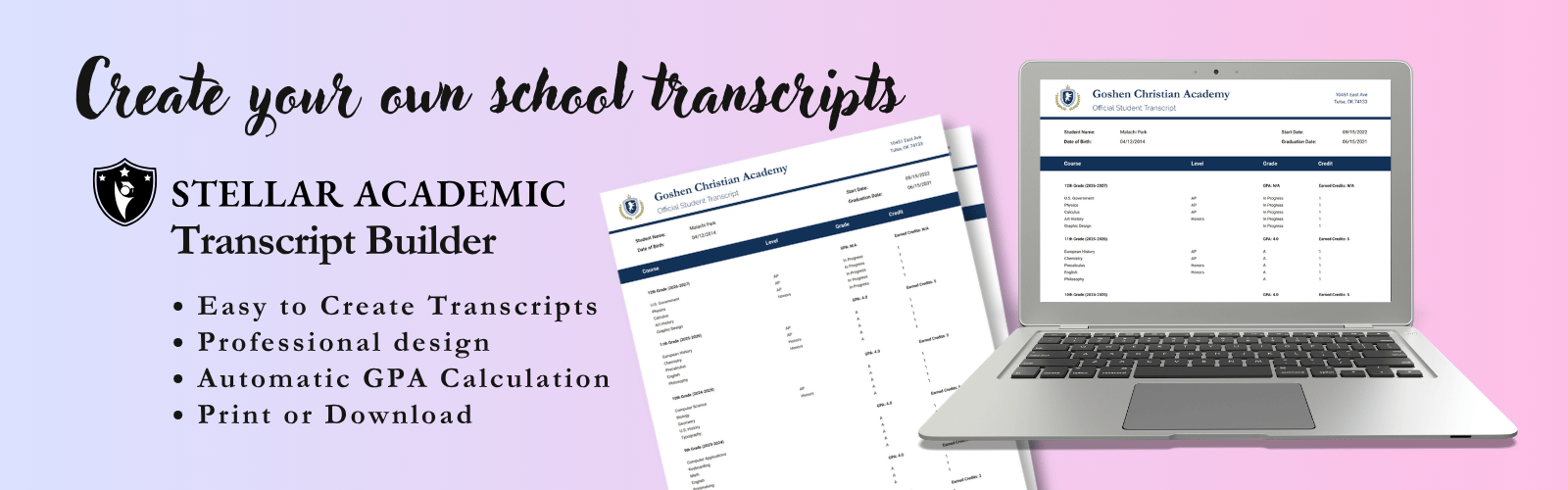
Need to highlight advanced academic rigor without spending hours adjusting table margins? Stellar Academic features a professional transcript builder crafted specifically to handle unique homeschool documentation needs. Specialized tools let you track courses, grades, and attendance in real time. When it comes to documenting AP and CLEP exam scores on homeschool transcripts, the system lets you input standardized scores right alongside academic terms or format them into a crisp testing block. You get a balanced, elegant document that instantly satisfies university standards.
Centralized Document Storage and Long-Term Peace of Mind
College admissions teams often request verification files months after you submit an initial application. Instead of rummaging through desk drawers for score summaries, take advantage of secure digital document storage. Our platform brings all your vital educational records together so you can stay organized across every academic term:
- Score Verification Archives: Upload and store official College Board score report PDFs right alongside corresponding coursework for quick retrieval.
- Interactive Dashboard: Monitor multi-year credit accumulation, GPA trends, and completed testing milestones from a centralized, real-time command center.
- Graduation-Ready Exporting: Produce polished, complete academic records ready for scholarship committees and admissions offices at a moment's notice.
Having total command over your student's records brings incredible peace of mind. By simplifying the administrative side of documenting ap and clep exam scores on homeschool transcripts, you get to spend less time wrestling with formatting software and more time celebrating your student's hard-earned accomplishments!
Showcase Your Student's College Readiness with Complete Confidence
Highlighting high-level achievement on your student's high school record doesn't have to be overwhelming. When you follow clear naming conventions, separate high school coursework credits from college exam credit, and choose an uncluttered layout, you turn testing milestones into powerful admissions assets. Mastering the art of documenting AP and CLEP exam scores on homeschool transcripts ensures university committees instantly recognize the depth and rigor of your teen's academic journey.
You've poured incredible dedication into your homeschool years, and your records should reflect that hard work! Stellar Academic provides the tools you need to succeed, featuring a specialized professional transcript builder, secure document storage for academic records and exam reports, and an integrated course, grade, and attendance tracking dashboard. Ready to create an impressive, college-ready record? Build your professional homeschool transcript with Stellar Academic today and take the next step toward your student's bright future!
Frequently Asked Questions
Can I write 'AP' on my homeschool transcript if my student only took the exam?
No, you cannot use the standalone "AP" label in course titles unless your syllabus passed the official College Board AP Course Audit. The College Board strictly enforces trademark rules for high school courses. Instead, title the class "Honors Biology (with AP Exam)" or "Advanced Biology." This accurately signals advanced high school coursework while preserving integrity when documenting ap and clep exam scores on homeschool transcripts.
How do colleges award credit for CLEP scores earned during high school?
Colleges evaluate CLEP scores against their individual transfer policies, typically granting introductory credit hours rather than course grades. Over 2,900 institutions recognize CLEP exams, usually requiring a minimum scaled score of 50 for credit. These credits satisfy general education requirements once official score reports arrive from the testing agency, potentially saving thousands in future tuition costs while shortening your student's path to college graduation.
Do high school transcripts replace official College Board score reports for admissions?
No, high school transcripts never replace official score reports sent directly by testing agencies. Your transcript alerts admissions officers to coursework rigor and gives context during initial holistic evaluations. However, to actually receive transferable credit hours or advanced course placement, universities require official digital score reports sent straight through your student's College Board portal. Always check each institution's submission deadlines to ensure scores arrive smoothly.
What happens if my student receives a low score on an AP or CLEP exam?
A disappointing exam score does not ruin your student's high school transcript or academic standing. Because transcripts reflect completed high school coursework rather than testing histories, you can choose to omit lower scores from your document. You still award the high school credit and course grade earned at home. Colleges will simply evaluate your student based on their coursework, letters of recommendation, and other application materials.
Is high school credit granted for passing a CLEP test without a separate course?
Yes, you can award high school credit for a passed CLEP test, but you must document it transparently. Many families list these achievements in a distinct "Credit by Exam" section rather than assigning an artificial letter grade. Documenting ap and clep exam scores on homeschool transcripts this way clarifies that credit was earned through demonstrated subject mastery rather than a structured, parent-graded semester course.
How should weighted GPAs be calculated for AP courses on homeschool transcripts?
Weighted GPAs typically add one full quality point (+1.0) to the standard 4.0 scale for authorized AP coursework. Under this system, an "A" equals 5.0, a "B" equals 4.0, and a "C" equals 3.0. Always publish both weighted and unweighted cumulative averages on your transcript. Include a clear grading key at the bottom so college admissions counselors easily understand your calculation method.
Track grades, courses, and homeschool records with Stellar Academic
Start your free trial of Stellar Academic today — no credit card required, just sign up and see the difference for yourself!

Stellar Academic is an education technology company dedicated to helping families manage the homeschool experience with clarity and confidence. Our platform brings together course management, grading, attendance tracking, and transcript generation into one intuitive system — giving parents the tools of a traditional school without the administrative burden.